
The Practical Path to Success and Why You Should Consider Trade School 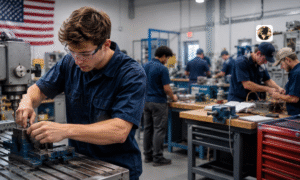
Right now education feels like it’s moving fast. People at different stages wonder if college is still worth it. Years ago everyone said you had to go to university to get ahead. That idea ruled thinking for so long. Now things are changing though. Tuition keeps going up. Some degrees don’t lead anywhere clear anymore. Because of this more people look again at trade schools. They see them differently than before. Training programs teach real skills quickly. Learning happens by doing instead of just listening. Classrooms often feel connected straight to jobs. Finishing means starting work faster. Debt ends up much lower too.
Bridging the Skills Gap in a Fast Changing Job Market
What makes trade schools worth looking at now? A shortage of hands-on workers keeps growing. Even as computers replace office jobs, fields like electrical work, heating and cooling repair, or welding don’t slow down. Think about it – buildings need power, people want warm houses, factories must operate. Bodies on site matter here; fingers fixing things beat software every time. Machines can’t twist pipes or rewire panels the way humans do. That stubborn reality protects these careers from digital takeovers. Walk out of training with real abilities – the kind communities rely on daily. Not nice-to-have extras. The sort of talent without which nothing runs.
Truth is, this route makes solid financial sense. Picking a trade school usually leads to programs running half a year up to twenty-four months. Compare that to college paths locking in at least four full years. Shorter timeline brings two clear benefits: lower education costs and earlier entry into well-paying work. While one person finishes undergrad weighed down by loans, another stands several years ahead – already working, building savings, maybe even planning what comes next.
The Evolution of Specialized Training and Technical Mastery
There is a lingering misconception that vocational education is somehow less rigorous than academic study. In reality, the curriculum at a modern trade school is intensive and requires a high level of mathematical proficiency, spatial awareness, and technical literacy. Today’s technicians are often working with advanced diagnostics, computer-aided design, and complex circuitry. The training is immersive, forcing students to apply what they learn in real-time environments. This pedagogical style suits individuals who learn best by doing rather than by reading. In a trade school setting, the distance between the classroom and the job site is virtually non-existent, which fosters a sense of confidence and competence that is often missing in theoretical degree programs.
This mastery also opens doors to entrepreneurship. Many individuals who start their journey at a trade school eventually go on to own their own businesses. Once the technical foundation is laid and a few years of field experience are gathered, the transition to becoming a licensed contractor or shop owner is a natural progression. This level of autonomy is a core component of the “American Dream” that many university graduates struggle to find within the confines of a corporate cubicle. The ability to control one’s schedule, choose specific projects, and build a local reputation is a unique benefit of the skilled trades that is often overlooked in high school guidance offices.
Financial Freedom and Long-Term Career Stability
The conversation around student debt has reached a boiling point, making the affordability of a trade school a major selling point. While the average cost of a four-year degree can easily exceed six figures, vocational programs are often priced at a fraction of that amount. Many industries even offer apprenticeships where the student is paid to learn, effectively eliminating the need for predatory loans. This financial head start is a powerful tool for long-term wealth building. When you graduate from a trade school, you are entering a field where the “return on investment” is almost immediate. You aren’t just paying for a piece of paper; you are paying for a specific set of tools and knowledge that have a transparent market value.
Beyond the initial entry into the workforce, a trade school education offers a high floor for earnings. Because the skills are specialized, they are difficult to replace. This creates a level of job security that is increasingly rare. Even during economic downturns, people still need their plumbing fixed, their cars repaired, and their electrical grids maintained. The stability offered by these “recession-proof” careers provides a peace of mind that is invaluable in an unpredictable world. Choosing a trade school is not just about finding a job for next year; it is about securing a foundation for a lifelong career that can support a family and provide a sense of pride in one’s craftsmanship.
Looking Toward a Future Built on Skilled Expertise
As we look toward the future, it is clear that the prestige associated with different types of education is undergoing a much-needed correction. Society is beginning to realize that a trade school graduate is just as vital—and often as well-compensated—as a professional with a master’s degree. We are entering an era where specialized expertise is the ultimate currency. If you are someone who finds satisfaction in building, fixing, or creating tangible results, the vocational path offers a sense of fulfillment that is hard to replicate. The journey through a trade school is one of focus, discipline, and practical application, leading to a destination marked by high demand and personal agency.
Ultimately, the decision to pursue a trade school education is a strategic move for the modern worker. It reflects an understanding of the current economy and a desire to avoid the pitfalls of traditional academic inflation. By choosing this route, you are joining a community of professionals who literally build the world around us. Whether it is through the precision of a machinist or the ingenuity of a renewable energy technician, the impact of these roles is felt every day. Embracing a trade school education means embracing a future of stability, specialized skill, and the freedom to forge your own path in a world that will always need your hands and your mind.