
The Power of Emotional Influence: Yvonne Wennerlid’s Philosophy of Presence, Trust-Based Leadership, and the Fluidity of Human Growth
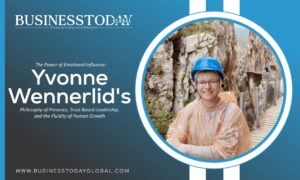
Influence is a two-way street. As one of the most influential women leaders, Yvonne Wennerlid’s path into coaching and personal development, as the Founder and Coach at Your Curiosity Path, has not been influenced and defined by a single moment, “but by a continuous awareness of how life shapes us through experience and response.”
Yvonne Wennerlid has always been interested in the space between what happens to us and how we choose to act, and how that space influences personal growth, identity, and direction. Alongside lived experience, she has explored structured learning in literature, philosophy, psychology, and the nature of learning itself, especially how we connect learning to life and life back to learning.
Literature has been a long-standing passion of hers, particularly mindset-focused books, biographies, and travel journals, which she also reflects on through her blog about books and journeys. These areas have shaped her understanding of human behavior and development in a grounded and reflective way.
Over time, she felt a natural pull to share her philosophy rather than keep it internal. Not as a desire to create an external imprint, but as a continuation of living consciously and observing how clarity emerges through experience. Her values have evolved significantly over the years, forming what she would describe as a practical and lived wisdom that guides how she approaches both challenges and growth. A major turning point came in early 2025 when she began to shape her coaching work and give it structure formally.
At the same time, life was already in a long and complex transition. Her mother had been living with dementia for several years and passed away in the summer of 2025. Her father became seriously ill during the summer of 2024 and also passed away in 2025, seven weeks apart from her mother. The immense grief and sorrow went deep inside her giving her strength and resilience at the same time. That period profoundly reshaped her understanding of presence, responsibility, and what it means to live meaningfully. It was not a sudden shift, but the culmination of a longer process of change that brought everything into sharper focus.
Creating Organizational Culture Where Everyone Feels Human Again
In parallel, Yvonne Wennerlid has always been drawn to creating environments where people step outside routine patterns. She has organized themed gatherings and experiences designed to bring people into presence through interaction, play, and shared human moments. A close friend later suggested turning this into structured offerings, which led to the development of party activations and later team activations for companies. These are not traditional team-building exercises, but experiences focused on presence, engagement, and authentic human connection.
Together, these elements form the foundation of her coaching practice, ‘Your Curiosity Path,’ which continues to evolve as a reflection of how she engages with life itself. For me, effective leadership is less about position and more about presence. She does not see leadership as something that is pursued for status or control, but rather something that emerges through responsibility, awareness, and the ability to stay engaged with complexity rather than reduce it. There is an important distinction between being a leader and being a manager or ‘the boss.’
In many contexts, authority can become tied to ego, where direction is driven more by control than by genuine engagement with others. Leadership, in contrast, is not about standing above a group, but about participating within it while still being able to guide movement when needed. Communication sits at the core of this dynamic. Active listening is essential, not selective listening shaped by personal preference or position. Any group is inherently diverse, shaped by different backgrounds, experiences, ages, and perspectives. Leadership, in this sense, is the ability to hold that diversity without trying to flatten it into sameness. Human interaction is also shaped by perception and self-image. People often respond not only to situations themselves, but to how they believe they are expected to behave within those situations.
When individuals are invited to step outside their usual patterns of identity and experience a situation from another standpoint, something shifts in how they relate to both themselves and others. These shifts are not fixed outcomes, but momentary openings that can change how people engage with each other. “I do not see leadership as something static or final,” she shares. No image of a person, a group, or a situation is ever fully complete or permanently defined. It is always in motion, influenced by context, time, and interaction.
Coaching and Guiding Life with Meaningful Change
This is also where coaching becomes meaningful, feels Yvonne Wennerlid. At Your Curiosity Path, coaching is not about directing from above, but about listening, observing, and asking questions from different angles without imposing interpretation, she says. It is a collaborative process where meaning is not delivered, but explored together in real time.
One of the most common challenges people face in personal and professional growth is the belief that life has a fixed and predefined path. Many are shaped by expectations around success, achievement, and the idea that mistakes should be avoided at all costs. This often creates a narrow view where hard work and constant effort are seen as the only valid way forward. In reality, growth is influenced by much more than structured effort and working hours.
“What we do outside of work, how we recover, relate, and engage with life, has a direct impact on how we show up in professional contexts as well,” she adds. Yet many people separate these parts instead of seeing them as connected. “From an early age, most of us are taught to fit into systems and expectations, often with the fear of standing out or being judged,” she reminds. This can lead to people limiting themselves before they even explore what else might be possible.
A common pattern is also the tendency to define others, and ourselves, through roles such as jobs or titles, even though they only represent one part of a much broader human experience. Change is often misunderstood as a single decision or a big step, but in practice, it is rarely that simple. It is usually a process of continuing forward while life shifts, expands, and contracts in different directions. Progress is not linear, and neither is development. Challenges arise when expectations and plans become rigid. When outcomes do not unfold as imagined, it can lead to disappointment or discouragement. In those moments, it becomes important to reassess not only the plan but the assumption that plans guarantee outcomes. Life does not follow fixed scripts, and uncertainty is part of every process.
In Yvonne Wennerlid’s work, she helps people by bringing attention to these patterns and asking questions that shift perspective. The aim is not to replace one fixed idea with another, but to create room for observation and reflection so that decisions can be made with more awareness of context, timing, and personal alignment. Growth is not about forcing direction, but about understanding how to move with what is actually present, rather than what was expected.
Redefining Success by Creating Sustainable Daily Routines
Confidence and resilience are essential qualities for success, believes Yvonne Wennerlid, and adds that the word ‘resilience’ has become something of a modern buzzword, often framed as a quality people should constantly build in order to handle more pressure and perform better.
In reality, many people are not looking for more pressure or endurance, but for more freedom in how they think and relate to life. There is an important difference between being serious about what you do and slowly wearing yourself out in the process. That distinction is often much larger than it appears.
Confidence, in her view, is not something that comes from convincing yourself that you are ‘enough’ in a fixed sense. It is more connected to the willingness to engage with life without predetermined rules about how it should be lived. It grows through curiosity and the readiness to explore directions that are not already defined by expectation or external structure.
The word ‘success’ is often tied to achievement, performance, and external validation. Yet it can also be understood in a quieter way, as a sense of alignment within oneself and in the small daily patterns that shape how we live. These routines and choices often define us more than any single milestone. A recurring challenge is the tendency to measure everything against fixed standards, even though people begin from very different starting points in life. This can create unnecessary pressure and a distorted sense of progress.
In her work, she encourages people to step back from overused concepts and observe what they actually mean in their own context. When language becomes less rigid, there is often more space to notice what feels sustainable, relevant, and real in daily life. Not everything needs to be elevated into a principle. Sometimes it is enough to simply see things as they are.
Erasing the Control Trap to Nurture Trust-Based Leadership
One of the most significant challenges Yvonne Wennerlid has encountered throughout her professional journey relates to leadership and workplace dynamics. In particular, she has experienced environments where leadership has been overly controlling, often directed at capable adults who do not need constant supervision. In such settings, excessive control tends to create uncertainty rather than stability, and can lead to unnecessary mistakes instead of preventing them. She has also noticed that over-explaining or simplifying communication can sometimes stem from insecurity rather than clarity. When this happens, the message is often adjusted downward rather than communicated with trust in the receiver’s ability to understand and act.
At the same time, she has worked with and observed many strong leaders who demonstrate a very different approach. They are attentive to the atmosphere of a workplace, aware of the people within it, and able to create direction without constant control. They trust others to perform their roles while maintaining clear and respectful communication. This has shaped her understanding of what perseverance and endurance mean in practice. She does not see value in persistence for its own sake if it is disconnected from reflection or awareness. Continuously pushing forward without addressing underlying issues can create resistance rather than progress. Real leadership involves the willingness to address difficult topics directly, rather than avoiding them out of discomfort or conflict avoidance.
Communication plays a central role in all of this. Language is powerful, and interpretation is never fully predictable. Attempting to control how messages will be received is ultimately impossible, which is why trust and clarity in intention matter more than trying to manage every possible reaction.
Overall, her experience has shown her that respectful and stable environments are built through trust, presence, and open communication. She has seen both ends of the spectrum: workplaces where people thrive, and environments where uncertainty and lack of trust create distance. These experiences have deeply influenced how she views leadership and human interaction.
Letting People Evolve on Their Own
What motivates Yvonne Wennerlid to continue this work is a growing need for a shift in how people relate to themselves and their lives. In many contexts, there is a strong focus on speed, achievement, and external markers of success. She believes there is value in stepping back from that pace and reconnecting with a more grounded way of living, where presence and everyday experience carry more weight than constant pursuit.
She observes a common pattern. People often attach their sense of identity to external factors, including material success or fixed ideas about who they are. Yet these things are not stable. Life continuously changes through new experiences, encounters, and circumstances. Because of this, identity is not something fixed, but something that naturally evolves over time. Many people become attached to certain self-definitions because letting go of them can feel uncertain.
However, holding onto a rigid version of oneself can also become limiting. There is often a fear of not knowing what lies beyond those self-imposed boundaries, even though life itself constantly invites movement and change. In her view, authenticity is not something performative. It is reflected in how a person is present in communication, expression, and interaction. Much is revealed through subtle cues such as tone, expression, and presence in conversation, often more than through words alone. She often reflects on how differently life might feel if it were seen less as something to perform and more as something to experience.
If life were viewed as a film or a book, the question becomes whether we would want to simply repeat the same script or remain open to new chapters and perspectives as they emerge. Creating meaningful impact, for her, is not about pushing people toward dramatic change. It is about supporting a willingness to loosen fixed patterns and explore new ways of engaging with life, without needing everything to remain predictable or defined in advance, in making important life and career decisions while staying aligned with their values and goals.
Expanding Perspectives and Dismantling External Judgments
Yvonne Wennerlid guides individuals through open conversations where the focus is less on providing answers and more on creating space for them to explore their own thinking. In many cases, people already carry a sense of what they want, but hesitate to express it clearly due to concerns about judgment, expectations, or external opinions.
Questions such as “What will others think?” or “How will this be perceived?” often play a larger role in decision-making than the individual’s own inner direction. Her approach is rooted in dialogue and communication, where different perspectives are introduced to expand thinking rather than narrow it. This can involve small or larger shifts in perspective, such as engaging with unfamiliar topics, exploring different forms of learning, or simply breaking habitual patterns of thought and routine. It can be as simple as experiencing art differently, reading outside one’s usual interests, learning about unfamiliar subjects, or engaging in activities that create presence and curiosity. These experiences are not about productivity or optimization, but about widening the lens through which life is viewed. By stepping into unfamiliar contexts, people often reconnect with a sense of exploration that is not driven by pressure or expectation. Values are not static. They evolve over time through experience, reflection, and exposure to new perspectives.
Recognizing this makes it easier to approach decisions with less rigidity and more openness. While structure and focus are important in professional life, there is also value in allowing more fluidity in personal exploration, where choices are not always defined by fixed rules or external validation. Ultimately, her role is to support people in seeing that decision-making is not about finding a single correct path, but about understanding themselves well enough to move forward in a way that feels aligned with where they are at this moment in time.
Openness, Time Awareness, and Rejecting Over-Scaled Human Labels
Yvonne Wennerlid believes that openness will be one of the most important leadership qualities for the future. This includes the ability to ask difficult questions and to engage honestly with answers that may not always be comfortable. It also involves staying receptive to new perspectives while maintaining a grounded sense of what one stands for in one’s work. There is also an increasing need for people to recognize the value of their time. Time is not renewable, and delaying action often reflects hesitation rather than genuine timing.
In this sense, leadership is closely connected to the ability to act with awareness rather than postponement driven by uncertainty or external pressure. At the same time, there is a tendency to categorize people into roles such as leaders, entrepreneurs, or generations. While these labels can be useful in certain contexts, they also risk oversimplifying constant human development.
People and systems are always changing, and effective leadership requires awareness of these shifts and the conditions that shape them. She also sees a growing need to return to a more measured approach, where smaller and more focused contributions are valued instead of constant expansion. The pressure to scale quickly and perform at high levels can create stress and lead to disengagement. In contrast, working on a smaller, more intentional scale often allows for greater depth and sustainability.
Leadership, in its most meaningful form, is not centered on visibility or self-expression alone. It is rooted in a genuine interest in people, the ability to listen, and the willingness to engage in real conversations rather than focusing primarily on output or numbers. In the future, she believes these human-centered qualities will become increasingly important as a counterbalance to speed, performance, and external pressure.
A Legacy of Ease – Cultivating Curious and Human-Centered Daily Rhythms
As a leader, mentor, and coach at ‘Your Curiosity Path,’ what Yvonne Wennerlid hopes to leave behind is a reminder to soften the way we relate to life. In many contexts today, there is a strong emphasis on achievement, performance, and external success. While ambition has its place, these expectations can also create pressure that makes people feel less capable or less worthy if they do not follow the same pace or path as others. She believes it is important to recognize that people are different. “We have different capacities, interests, and ways of moving through life. Much of what we experience as limitation is often shaped by comparison rather than by actual ability or potential. At the same time, growth and development remain important.”
Curiosity plays a central role in this. There is always space to learn, refine, and evolve in many areas of life. The key is to act from one’s own life rather than feeling controlled by external expectations or standards that do not necessarily fit who we are. She aims to contribute to a perspective where presence and curiosity are valued alongside ambition. Where people are allowed to take their lives seriously without becoming rigid or overly pressured by it.
Life does not need to be lived in extremes. It can also be explored with a sense of openness, play, and reflection. There is also value in allowing more lightness into how we live and work. To not always take ourselves too seriously, and to remain able to laugh, observe, and step back when needed. “Well-being is deeply connected to how we relate to our thoughts, our bodies, and our daily rhythms, and to how we integrate learning and experience into everyday life.” Nature, simplicity, and moments of rest also play an important role in this balance. “They remind us that we are part of something larger than our performance or output.” If there is any message she hopes to leave with aspiring coaches and women leaders, it is this: live with engagement, but also with ease. Stay curious. Stay human. And allow life to be both meaningful and light at the same time.
The word “coach” has become increasingly broad over time, and in many ways it has also become diluted, says Yvonne Wennerlid. Originally rooted in the world of sport, where a coach guides performance and development in a clear direction, it is now used across a wide range of fields. This expansion raises an important question: what does the role actually mean today?
With so many people adopting the title, often without a shared foundation or approach, the term can lose some of its original weight. In practice, coaching can vary significantly from one person to another, even when similar language or methods are used. This highlights a key point: there is no single method that fits all individuals.
In her view, coaching is less about predefined techniques and more about understanding the person in front of you. It is not about applying the same questions or frameworks universally, but about meeting each individual with presence, curiosity, and genuine attention. Communication and listening become more important than instruction or direction.
There is also a growing tendency for people to enter the field through courses or certifications without necessarily developing a deeper understanding of human behavior and interaction. While education has value, the essence of coaching lies in the ability to stay present in conversation and respond to what is actually emerging, rather than relying on fixed formulas.
Looking ahead, Yvonne Wennerlid feels that the role of coaching will likely continue to evolve as people search for direction in increasingly complex environments. At the same time, there is a risk that external noise and constant expansion of input can pull people further away from themselves. In response to this, she believes there will be a growing need to simplify focus, return to smaller and more intentional circles, and prioritize what is truly meaningful in daily life.
“Ultimately, life itself is the most important context we work within,” she says, and adds that coaching, in its best form, supports people in engaging with that reality more consciously, rather than trying to impose structure onto it.