
The Forward-Looking Finance: Mutaf Rifat’s Vision for Strategic Partnership
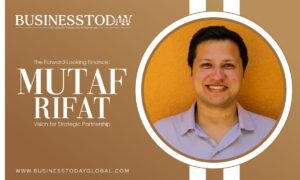
The ever-changing times of 2026 are such that the London financial district demands more than just record-keeping. It requires the most influential and visionary leader. One who can see through the fog created by the concurrent global market shifts and then clear that smoke to show a path ahead. Mutaf Rifat walks at this frontier’s leading edge as the Founder and Chief Executive Officer (CEO) of Future CFO. He brings years of experience analyzing financial data and predicting trends to ensure that businesses do not just survive but thrive. He views the role of the modern executive as a strategist who looks beyond the balance sheet to find hidden opportunities for growth.
Mutaf spends his days monitoring cash flow and conducting detailed audits to safeguard the stability of the organizations he serves. He understands that every budget allocation represents a choice about the future direction of a company. By evaluating potential earnings and expenses with clinical precision, he summarizes the financial standing of a business in strict accordance with regulatory guidelines. This technical mastery allows him to provide the kind of financial leadership that enables strategic foresight for his entire team.
Leading Financial Transformation and Change
His expertise shines most brightly during periods of transition. Mutaf excels at financial transformation and change management, helping companies update their old systems to meet new demands. He actively restructures finance departments to enhance performance and boost overall profitability. By supervising staff with a focus on professional development, he builds teams that can think critically about business outcomes. His approach turns the finance function from a back-office necessity into a powerful engine for success.
The Vision of a Strategic Partner
As a CEO shaping the landscape of 2026, Mutaf believes that the best leaders act as thought partners to their clients. He rejects the idea that finance should be isolated from the rest of the business. Instead, he integrates financial insights into every strategic decision, from marketing to product development. He often sits with other founders to help them understand how a well-managed cash flow can become their strongest competitive tool. His focus remains on the practical application of data to solve real-world business problems.
A Calm and Methodical Approach
The current economic environment presents constant challenges, yet Mutaf approaches them with a calm and methodical perspective. He continues to refine his methods for identifying financial risks before they become crises. Every project he leads serves as a benchmark for how modern companies should manage their capital and their people. As he prepares to meet with a new group of global investors, he stays committed to the idea that financial clarity is the foundation of any great achievement. The market continues to evolve, and Mutaf remains ready to guide his partners through the next era of professional excellence.
The Evolution of a Financial Visionary
Mutaf’s journey spans financial leadership across global organizations, with many pivotal moments shaping his transition into founding Future CFO. He has always been curious about one thing: what does the future of finance actually look like? His own background is fairly traditional. He is ACA qualified, worked across financial leadership roles, and spent years doing what most finance professionals are trained to do: understand numbers, ensure accuracy, and explain what has already happened. But over time, he kept coming back to a bigger question: Is that enough?
Bridging the Gap Between Past and Future
The real turning point came during COVID. Like most people, Mutaf watched how quickly the world changed, business models disrupted overnight, funding uncertain, organizations scrambling to make decisions without clarity. And what became obvious very quickly to him was this: most finance functions were built to explain the past, not guide the future. That gap stayed with him. He saw that there were plenty of good accountants, but not enough people acting as true thought partners to leadership teams. Not enough finance professionals were helping answer the question that actually matters: what happens next?
The Birth of Future CFO
That is where the idea for Future CFO came from. Then there was that inspiration to build a company that positions itself as a “one-stop financial expert” for SMEs, INGOs, and startups. When Mutaf started looking at the market more closely, the gap became even clearer. If you are a large organization, you have access to top-tier firms, the Big Four, advisory networks, and full finance teams. If you are a very early-stage startup, you can get by with a freelancer or a bookkeeper. But there is a middle segment, growing organizations, NGOs, scale-ups, that often gets overlooked. These organizations need proper finance support. Not just bookkeeping, not just reporting, but strategic thinking. The challenge is that they cannot always afford to build a full finance team internally.
The Three-Layered Strategic Model
And in reality, Mutaf believes every organization needs three layers: someone to handle the day-to-day data, someone to manage reporting and controls, and someone to act as a strategic partner at the leadership level. Most companies cannot hire all three. So instead of selling individuals, he built something different. A model where you effectively “buy” a finance function. A one-stop approach where you get access to all three layers, CFO, finance manager, and execution, tailored to what you actually need. It sounds simple, but it solves a real problem. Future CFO emphasizes strategic financial transformation.
An Embedded but Objective Partnership
One of the things that makes his approach different is where they sit. Mutaf and his team are not traditional consultants who stay external and deliver reports. But they are also not fully internal hires who get pulled into day-to-day operations. They sit in between. For some clients, that means joining leadership meetings or retreats. For others, it is being part of regular decision-making cycles. The goal for him is always the same: to understand the business properly, not just the numbers. At the same time, they keep an external perspective. That balance, being embedded but not absorbed, is what allows him to add value. And importantly, he does not believe in a standardized model. Every organization is different. What works for a startup will not work for an international NGO? So everything Mutaf and his firm do is tailored.
From Retrospective Analysis to Strategic Foresight
Mutaf believes in more than leveraging financial data to drive strategic foresight, rather than just retrospective analysis. Data, of course, still matters. It’s the foundation of everything. If his data is wrong, his decisions will be wrong. That part hasn’t changed. But what has changed is where the real value sits. Producing reports, closing month-end accounts, and building dashboards are all important, but increasingly they can be automated. The real question for him is not what the numbers are, but what they mean.
What does this tell him about his cash runway? What does it mean for his next funding round? Is he growing sustainably, or just expanding risk? That’s where he and his team focus their time. Mutaf looks at the data, but he also layers on experience, patterns he has seen across different organizations, sectors, and geographies. And then he translates that into something leadership teams can actually act on. Because ultimately, finance is only useful if it drives decisions.
The Shifting Mindset of Financial Leadership
When it comes to the most critical financial trends, one of the biggest changes Mutaf has seen, especially over the last few years, is how founders and leaders think about finance. Historically, finance was often an afterthought. The priority was always growth, sales, marketing, and expansion. Finance came in later to “tidy things up.” That mindset is shifting. More organizations are realizing that having the right finance partner early on can actually drive growth, not just support it. It affects how they raise funding, how they manage cash, and how they make strategic trade-offs.
At the same time, there’s a growing acceptance of fractional models. Mutaf notes that not every business needs a full-time CFO, but many need access to that level of thinking. In a world where uncertainty is becoming the norm, understanding a financial position, burn rate, resilience, and options is no longer optional. Technology, especially automation and financial software, is obviously a big part of this shift.
The Integration of Technology and Human Judgment
Automation has already changed how Mutaf’s finance teams operate. Processes that used to take weeks are now moving towards real-time visibility. Month-end is no longer a fixed event; it’s becoming continuous. AI is accelerating that even further. But he doesn’t see it as replacing finance professionals; he sees it as raising the bar. The people who rely purely on manual processes will struggle. The ones who understand how to use technology, and more importantly, how to interpret the output, will become more valuable.
For Mutaf, the focus is clear. He uses technology to remove inefficiencies, but doubles down on the thinking layer. The interpretation, the judgment, and the ability to guide decisions, that’s where the role is heading. Being recognized among influential CEOs in financial solutions is something he is genuinely proud of, but not for the obvious reasons. It’s not just about the title; it’s about what it represents.
The Vision of Impactful Partnerships
From day one, the vision behind Future CFO was simple for him: finance should be forward-looking, practical, and genuinely useful to organizations. Not just compliant, not just accurate, but impactful. So the recognition feels like validation of that idea to him. More importantly, it reflects the work the team has put in over the years. Because none of this is individual; it’s always collective.
Despite everything evolving, technology, business models, and markets, some principles remain constant for Mutaf. The biggest one is this: always start with the problem you are trying to solve. It sounds obvious, but he knows it’s easy to lose sight of. As finance professionals, they are trained to focus on rules, processes, and outputs. But real impact comes from understanding what they are actually trying to solve. Once that’s clear, everything else becomes a tool. Data, systems, and reporting all serve the same purpose. He also places a lot of emphasis on thinking like partners, not service providers. That means taking ownership of outcomes, not just delivering outputs.
Building High-Performing Global Teams
While building and leading high-performing finance teams that align with long-term organizational goals, internally, a lot of this comes down to how Mutaf builds his team. He operates across multiple countries and sectors, so diversity of thinking is a strength for him. Different perspectives often lead to better decisions. But alignment is key. Everyone who joins understands the core idea behind Future CFO, that they are here to support decisions, not just produce reports. That mindset shapes how they work with clients and with each other. And one thing he repeats often is this: focus on the bigger picture first, then work backward. It’s simple, but it keeps everyone aligned.
The Power of Simplified Communication
If there’s one skill that’s underrated in finance, Mutaf believes it’s communication. He deals with complex information, multiple variables, detailed data, and technical concepts. But if he cannot translate that into something clear and actionable, it loses its value. Sometimes the most useful thing he can do is simplify. Do not oversimplify, but distill the message down to what actually matters. What does the leadership team need to know? What decision needs to be made? Being able to communicate that clearly is often more important than the analysis itself.
Strategic Expansion and Intelligent Growth
Now, Mutaf’s long-term vision for Future CFO as it continues to expand globally is pragmatic. As a business, they are still growing. He has expanded across different regions, the UK, Dubai, and beyond, and he is seeing strong demand in markets like the Middle East, East Africa, and the US. The NGO sector remains a big focus for him, but he is also moving into other industries. At the same time, AI and automation will play a central role in how he scales. The goal is not just to grow, but to grow intelligently, using technology to increase efficiency while maintaining quality. He has grown quickly over the past few years, but he genuinely believes the biggest phase is still ahead. Because the role of finance itself is still evolving.
Advice for the Next Generation of Leaders
For anyone looking to move into strategic finance or leadership roles, his advice is simple. Focus on the bigger picture. Don’t just produce numbers, understand what they mean. Ask better questions. Challenge assumptions. Think beyond the spreadsheet. And be willing to take risks. When Mutaf started Future CFO, he didn’t have everything figured out. He had a direction, a sense of the problem he wanted to solve, and he backed himself. A lot of the rest came through trial and error. That’s part of the process for him. At the end of the day, tools will change. Technology will evolve. But if he stays focused on solving real problems, everything else tends to fall into place.
The Future of the Finance Function
For Mutaf, the future of finance isn’t about replacing what already exists; it’s about evolving it. The fundamentals will always matter, but the real shift is in how he uses that foundation to drive decisions, not just report on them. That’s where he believes the biggest opportunity lies over the next decade. He remains committed to ensuring his firm leads this transition by bridging the gap between historical data and future action.