
Amazon CEO Andy Jassy: Career, AWS and Leadership
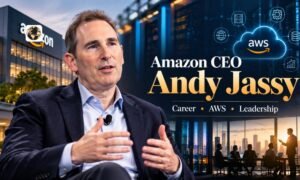
When Andy Jassy joined Amazon in 1997, the company was still building its identity as an online retailer. Nearly three decades later, he leads one of the world’s largest technology companies. The Amazon CEO Andy Jassy story is closely connected to the creation of AWS, Amazon’s expansion into cloud computing, and the company’s growing focus on artificial intelligence.
Jassy became Amazon’s CEO in July 2021 after Jeff Bezos moved into the role of executive chair. Before taking the top job, Jassy had spent years building AWS from an early-stage idea into a major cloud computing business.
Who Is Amazon CEO Andy Jassy?
Amazon CEO Andy Jassy is the president and chief executive officer of Amazon.com and also serves on the company’s board of directors. He joined Amazon in 1997 after completing his undergraduate studies at Harvard University and later earned an MBA from Harvard Business School.
His career at Amazon included several leadership positions before he became closely associated with AWS. That experience gave him exposure to both business-to-business and consumer operations before he took responsibility for developing Amazon’s cloud business.
Jassy’s path to the CEO position was therefore different from that of Amazon founder Jeff Bezos. Rather than creating the company itself, he spent years developing one of its most important businesses and eventually became responsible for the entire organization.
How Did Andy Jassy Build AWS?
The biggest chapter in Jassy’s career began with Amazon Web Services. He founded and led AWS from its inception and later served as its CEO from April 2016 until July 2021.
One important example was Amazon’s development of database services. The company’s first attempt failed to gain enough traction, leading the team to rethink the product and develop new relational and non-relational database services.
AWS also started with a much smaller technical footprint than it has today. Jassy noted that the first version of EC2 had a single instance type in one availability zone and lacked capabilities that later became standard parts of cloud computing.
The strategy changed as more businesses began moving workloads to the cloud. Netflix chose AWS for its applications in 2008, followed by major organizations including GE and Intuit. The CIA later selected AWS to help build its classified cloud.
When Did Jassy Become Amazon CEO?
Amazon announced in February 2021 that Jassy would succeed Bezos as CEO later that year. The transition took place in July 2021, marking a major change in Amazon’s leadership after Bezos had led the company since its founding.
The leadership transition did not mean Amazon was moving away from its technology businesses. AWS remained a central part of the company, while Jassy increasingly became responsible for a much broader collection of operations, including online stores, advertising, entertainment, devices, logistics, and emerging technologies.
His first years as CEO also coincided with major changes in the technology sector, including the rapid growth of generative AI.
What Is Andy Jassy’s Focus on AI?
Artificial intelligence has become one of the central themes of Jassy’s leadership at Amazon. In his 2025 shareholder letter, he described AI as a technology with the potential to affect customer experiences and businesses across Amazon rather than as a standalone project.
AWS is particularly important to that strategy. Amazon reported that AWS sales increased 37% year over year to $42.2 billion in the second quarter of 2026. The company also said its AWS AI business had exceeded a $25 billion annual revenue run rate.
What Has Changed at Amazon Under Jassy?
Under Jassy, Amazon has continued expanding beyond its traditional e-commerce identity. The company has been developing businesses in advertising, healthcare, entertainment, grocery, robotics, autonomous transportation, satellite connectivity, and artificial intelligence.
Amazon’s 2025 shareholder letter also highlighted Amazon Leo, the company’s low Earth orbit satellite network, alongside Zoox and robotics as areas where Amazon was still in relatively early stages of development.
At the same time, Jassy has emphasized that Amazon’s retail operation remains enormous. The company reported North American sales of $116.2 billion in the second quarter of 2026, while international sales reached $42.2 billion.
That combination of established businesses and newer technology projects helps explain the breadth of the Amazon CEO Andy Jassy role today.
What Leadership Lessons Has Jassy Shared?
His own history at AWS provides a clear example of that approach. Some early AWS ideas failed, while others became major products. The business grew by repeatedly adding capabilities in response to customer needs rather than remaining fixed around its original design.
For Jassy, that experience now applies to Amazon as a whole. His shareholder communications have repeatedly emphasized experimentation, long-term investment, and adjusting course when an idea does not work.
What Is Next for Amazon Under Jassy?
The next phase of Amazon CEO Andy Jassy’s leadership is closely tied to AI infrastructure, cloud computing, faster retail delivery, advertising, satellite connectivity, robotics, and autonomous transportation.
Amazon’s second-quarter 2026 results show how significant AWS has become to that strategy, with the cloud division reaching a $169 billion annualized revenue run rate.
Jassy’s career has therefore come full circle in an unusual way. He joined Amazon when it was primarily known for online retail, helped create AWS as a new technology business, and now oversees a company trying to connect e-commerce, cloud computing, AI, logistics, entertainment, and other technologies under one corporate structure.
Conclusion
The career of Amazon CEO Andy Jassy is closely tied to one of Amazon’s most consequential transformations: the creation and expansion of AWS. His move from leading the cloud business to running Amazon placed him at the center of the company’s broader technology strategy.
Today, his leadership is increasingly shaped by artificial intelligence and large infrastructure investments, while Amazon continues to operate major businesses in retail, advertising, entertainment, and logistics. The company’s latest results show how much AWS contributes to that broader strategy, making Jassy’s experience in cloud computing particularly relevant to Amazon’s next phase.